The Frequency That Quiets the Wired Mind

Saturday, 21 March 2026
petr barak

Petr Barák

Author, Designer

A randomised controlled trial using quantitative EEG finds that six hertz of binaural stimulation begins to reshape cortical activity within minutes — raising fresh questions about sound as a clinical tool for insomnia.

On a quiet night somewhere in Seoul, forty-three volunteers with troubled sleep pressed a set of headphones to their ears and listened to music. For half of them, woven invisibly beneath the melody, two pure tones played simultaneously — one into the left ear, one into the right, separated by exactly six cycles per second. They could not hear the difference. Their brains, it turns out, could.

The study, published in Brain Sciences in 2022 and conducted by researchers at Seoul National University Bundang Hospital, set out to answer a deceptively simple question: can a precisely tuned auditory illusion — a binaural beat — push the waking brain toward sleep? The answer, drawn from the electrical signatures of thought itself, is more nuanced and more promising than either enthusiasts or sceptics might expect.

A Phenomenon Born in the Brainstem

Binaural beats are not a sound you can record with a microphone. They exist only inside the skull. When the left ear receives a tone of, say, 256 Hz and the right ear receives 262 Hz, the brain perceives a phantom oscillation at the difference frequency — in this case, 6 Hz. The processing takes place not in the auditory cortex but in the medial superior olivary nucleus of the pons, a brainstem structure that normally helps localise sound in space by comparing the timing of signals from both ears.

What makes binaural beats medically interesting is a concept called entrainment, or the frequency-follow response. The brain’s electrical activity — its native rhythms of delta, theta, alpha and beta — has a tendency to synchronise with repetitive external stimuli. Drummers know this empirically. Monks have exploited it for millennia. The question science has been circling is whether a digital audio file can do the same thing reliably, measurably, in a clinical population.

“When the participants listened to music with binaural beats, the relative power of the theta wave increased. The brain, it seems, was listening more carefully than its owner.”
Brain Sciences, 2022 — Yoon, Bae & Cho et al.

Mapping the Insomniac Brain

Insomnia is not simply a failure to fall asleep. At its neurological root lies a state of cortical hyperarousal — an excess of high-frequency beta activity that keeps the brain in a state of alert wakefulness when the body has long since collapsed with fatigue. The resting EEG of a chronic insomniac looks, in certain respects, like the EEG of someone doing mental arithmetic. The lights will not go out.

The Seoul team recruited forty-three adults between the ages of twenty and fifty-nine with subclinical insomnia — people who lay awake far too long, woke too easily, and emerged from sleep feeling cheated, but whose symptoms fell short of the full diagnostic threshold for insomnia disorder. Their baseline Pittsburgh Sleep Quality Index scores averaged 8.7, well above the clinical cut-off of five. Crucially, none were taking sleep medications.

Participants were randomised into two groups. Both received an audio device and instructions to listen for thirty minutes before bed every night for two weeks. The test group’s device played music embedded with a 6 Hz binaural beat — a theta-frequency stimulus, targeting the brain rhythm most closely associated with drowsiness and the hypnagogic state at the edge of sleep. The control group’s device played identical music, with the binaural tone stripped silently away.

43 Participants, ages 20–59, subclinical insomnia
6 Hz Theta-frequency binaural beat, 30 min nightly for 2 weeks
1.02 Cohen’s d effect size — binaural beat group vs 0.58 music-only

What the Electrodes Recorded

To measure brain activity, researchers used a 64-channel quantitative electroencephalography system — essentially a swimming cap studded with electrodes, each recording the summed electrical chatter of millions of neurons below the scalp. Measurements were taken in a laboratory, twice: before the two-week intervention, and after. Fast Fourier transformation converted the raw EEG signal into a spectral map, revealing the relative power of each frequency band across five anatomical regions of the cortex.

The first finding arrived quickly. Before the two-week protocol even began, simply listening to music with a binaural beat for five minutes produced a measurable increase in theta power at the occipital region, at the back of the skull (p = 0.009). No equivalent shift was seen in the control condition. The brain was, apparently, following the rhythm within a single session.

After two weeks, the picture became more layered. Among those who had been using the binaural beat device at home, exposure to music with the beat in the laboratory produced elevated theta power at the parietal region (p = 0.009). More strikingly, the group that had listened to music with binaural beats for a fortnight showed a significantly greater reduction in beta power from baseline — the very signature of cortical hyperarousal — compared to the music-only group (p = 0.035, occipital region).

The Architecture of Drowsiness

To appreciate what a beta reduction means, it helps to understand the EEG landscape of falling asleep. In a healthy sleeper, the transition from wakefulness to Stage 1 sleep follows a characteristic choreography. Alpha waves — the 8 to 12 Hz oscillations of relaxed, eyes-closed wakefulness — begin to yield. Theta activity rises in the frontal and parietal regions. Beta power falls. The brain, in electrical terms, is dimming its lights. In the chronic insomniac, this transition is impeded; beta persists, alpha spikes, and the sleeper remains stranded in a neurological no-man’s-land.

The Seoul data suggest that binaural beat stimulation may be capable of nudging the brain toward exactly this transition. The selective increase in theta power, combined with the reduction in beta, traces the first steps of the dimming sequence. The effect size in the binaural beat group — Cohen’s d of 1.02, compared to 0.58 in the music-only arm — represents a clinically meaningful difference, even if the small sample prevented the broader symptom questionnaire scores from reaching statistical significance.
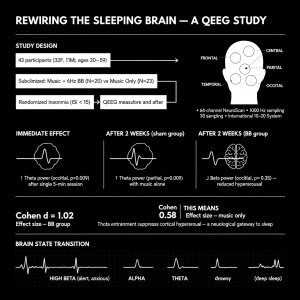
rewiring the sleeping brain

Infographic: QEEG study design, key findings, brain state transition
Fig. 1  ·  Study architecture, QEEG regions, key spectral findings and brain-state transition model  ·  Sonora Science Desk

Where Sound Meets Scepticism

The researchers are careful not to overreach. The study’s sample size — forty-three participants, with twenty in the active arm — limits the statistical power available. Subclinical insomnia may not translate to clinical populations. And using music as a carrier wave for the binaural tone introduces a confound: music itself is known to modulate arousal, and several earlier studies found no difference between binaural beat conditions and music-only controls when examining subjective sleep measures.

The habituation paradox also looms. After two weeks of nightly exposure, the resting EEG of the binaural beat group did not differ significantly from that of the control group during a no-stimulation baseline recording — suggesting that the brain may adapt to the stimulus over time, a kind of neurological familiarity that blunts the acute entrainment effect. This is consistent with findings in healthy subjects where prolonged theta-frequency exposure produced a theta blocking effect rather than enhancement.

The mechanism itself remains provisional. Whether entrainment works via direct cortical resonance, via modulation of the ascending arousal system, via relaxation-induced suppression of the hypothalamic-pituitary axis, or via some combination of pathways, remains unresolved. The brain is not a tuning fork. It is a dynamic system whose response to any periodic input depends on its current state, its history, and its individual architecture.

A Non-Pharmacological Door

What makes the study scientifically valuable, regardless of its limitations, is its methodological rigour. This was a randomised, double-blind, controlled trial with objective neurophysiological outcome measures — not a self-report questionnaire administered to volunteers recruited from a binaural beat enthusiast forum. The QEEG approach bypasses the well-documented susceptibility of sleep questionnaires to placebo effects and expectation bias.

The clinical context matters equally. Cognitive behavioural therapy for insomnia (CBT-I) remains the first-line treatment recommended by the American College of Physicians and the European guideline for insomnia, but it demands sustained effort, therapeutic access, and patient compliance that are unevenly distributed. Pharmacological options — benzodiazepines, Z-drugs, orexin antagonists — carry dependency risk, tolerance development, and in elderly populations, a substantially elevated risk of delirium, falls, and fractures. A safe, inexpensive, non-habit-forming adjunct that could accelerate sleep onset by modifying cortical state without biochemical side effects would represent a genuine clinical advance.

The Seoul researchers note that their device produced the entrainment effect without participants being able to consciously perceive the binaural beat — a factor that matters for blinding, but also for practicality. Users do not need to listen differently, focus on the sound, or adopt any particular mental posture. The brain processes the stimulus automatically, at a level below attention.

The Next Questions

Several variables remain unexplored. The optimal carrier frequency — the audible tone above which the binaural beat rides — may matter more than current evidence acknowledges. Prior studies have used carriers ranging from 240 Hz to 480 Hz, and findings are inconsistent. Duration and timing within the sleep cycle may be equally decisive: the point at which theta entrainment is induced relative to natural sleep-onset theta may determine whether it assists or disrupts the process.

Individual neurophysiological differences — baseline theta power, resting beta levels, the architecture of each participant’s sleep — also likely modulate response. A future trial equipped with a larger sample and individual EEG-guided dosing might clarify who benefits most and under what conditions. The researchers suggest that moving from subclinical volunteers to a clinical insomnia population, and pairing binaural stimulation with CBT-I, would be the logical next step.

For now, the Seoul study adds to a gathering body of evidence that the gap between the world of sound and the world of neural state may be narrower than neuroscience once assumed. Six cycles per second, imperceptible, invisible, woven beneath a piece of music chosen from a list — and the electrodes at the back of the skull begin to change their tune. Whether that is enough to unlock the insomniac brain from its own wiring remains, for the moment, a question worth losing sleep over.


Sources & References
  1. Yoon I-Y, Bae Y, Cho H-Y et al. “Brain Wave Entrainment of Binaural Beats in Insomnia.” Brain Sciences 2022; 12(3): 339. doi: 10.3390/brainsci12030339. PMID: 35326295.
  2. Qaseem A et al. “Management of chronic insomnia disorder in adults.” Ann. Intern. Med. 2016; 165: 125–133.
  3. Riemann D et al. “European guideline for the diagnosis and treatment of insomnia.” J. Sleep Res. 2017; 26: 675–700.
  4. Winkelman JW. “Insomnia disorder.” NEJM 2015; 373: 1437–1444.
  5. Lane JD et al. “Binaural auditory beats affect vigilance performance and mood.” Physiol. Behav. 1998; 63: 249–252.
  6. Draganova R et al. “Cortical steady-state responses to central and peripheral auditory beats.” Cereb. Cortex 2008; 18: 1193–1200.
  7. Padmanabhan R et al. “Binaural beat audio and pre-operative anxiety.” Anaesthesia 2005; 60: 874–877.
  8. Gao X et al. “EEG activity in response to binaural beats.” Int. J. Psychophysiol. 2014; 94: 399–406.
  9. Gray SL et al. “Benzodiazepine use and risk of incident dementia.” BMJ 2016; 352: i90.
  10. Sateia MJ et al. “Clinical practice guideline for pharmacologic treatment of chronic insomnia.” J. Clin. Sleep Med. 2017; 13: 307–349.

Sonora  ·  Science Desk  ·  March 2026 For educational and editorial purposes only. Not medical advice.

appstore
google play button